
NYM is a VPN, and it markets itself as a good one. The best arguably in terms of its security features. It's decentralized so that there is no main server you have to worry about tracking your data, you get effectively reimbursed the more you use it so that it costs very little, and it even has a very neat feature that will catch the eye of most people considering it: Inserting false data streams so that you're harder to track. They even have Chelsea Manning among others on their section of professional advisors who trust them (more on that later).
Now that all sounds great, but the reality is much more concerning. You probably already know about VPNs and have heard of Tor, so you should know what a good standard of service is. VPNs obfuscate where your traffic comes from so you can't be tracked, as well as encrypting traffic and ideally have a zero-log policy so your interactions can't be tied back to your IP address. Tor, on the other hand, can act as an VPN providing many of the same benefits but in a decentralized way by bouncing your traffic through other people's computers around the world, thus protecting you. With that out of the way, this is admittedly going to be more of a negative article, because while Nym sounds good, it is the fishiest VPN I've ever seen, and that's coming from an industry in which Kape, a company that used to distribute ad-ware, bought a number of VPNs (sorry Express VPN, CyberGhost, Private Internet Access, and other VPN users if this is how you found out you shouldn't trust your host company), as well as review sites to boost their rankings and game the system.
First, I do want to like Nym, they changed their pricing to be more affordable, they use multiple methods to protect your information, and they are open source. Those are a few good things.
Second, the bad.
Now the pricing situation isn't that bad anymore. Maybe fishy, but far improved from what it was. Currently at the time of writing (November 2026), you can get it for $4/month when buying a year at a time. You can even get it for one dollar a month if you pay in NYM, their crypto currency.
There's a lot to unpack here but it does make sense. While places like Tor operate on being volunteer/open source with sponsors to help fund a dedicated development effort, NYM instead opts to save money. It's not the only one who does this. IVPN, for example, also charges a monthly fee for a decentralized VPN.
Some people are probably wondering why I said "decentralized" right there, and that's because when it is decentralized and operating across other people's host computers as part of the "mixnet", that means they dont have to worry about server costs as much as others. If you are the nodes in the network, why are they making you pay? I'd just say it is good practice to pay the people making the things you want. Not all the cost is server infrastructure, and its clear that this does take effort to build. Since it's open source, I think it would be possible that someone can implement these features elsewhere if they really wanted too, so I'm not against them getting a little funding to try to bring something nice to the table for everyone.
Pricing has not always been what is it currently though. It has decreased a bit recently. While paying month to month is currently $8/month, just a year ago it was to be $13/month, and if you paid for 2 years (which is no longer available), it was $5.49/month. This is not only much more expensive than a VPN with little server infrastructure at all compared to most VPNs costs, but it is also in many ways a worse deal and unless they issues some sort of refund, a betrayal to your original customer base. If you got in early, you'd be paying about 50% more.
Now, about that NYM cyptocurrency. Basically, the more you use NYM, the more coin you get. There are not specified amounts that I saw that you earn for hosting a node. Simply a dangled carrot for you to participate. You do however need some NYM coin to get started with a node.
Some pretty good tech can work on blockchain to try to keep privacy while maintaining integrity. For example, Jami uses blockchain tech in its decentralized services to keep a consistent network across devices for device ID/usernames and whatnot while maintaining privacy.
This is where we hit the part that I get really suspicious of though. You need to buy into the coin in order to have a node according to their FAQ. So you have to buy crypto to run a node to earn crypto. Hmm. It on some level makes sense, but lets check the value of said cryptocurrency.
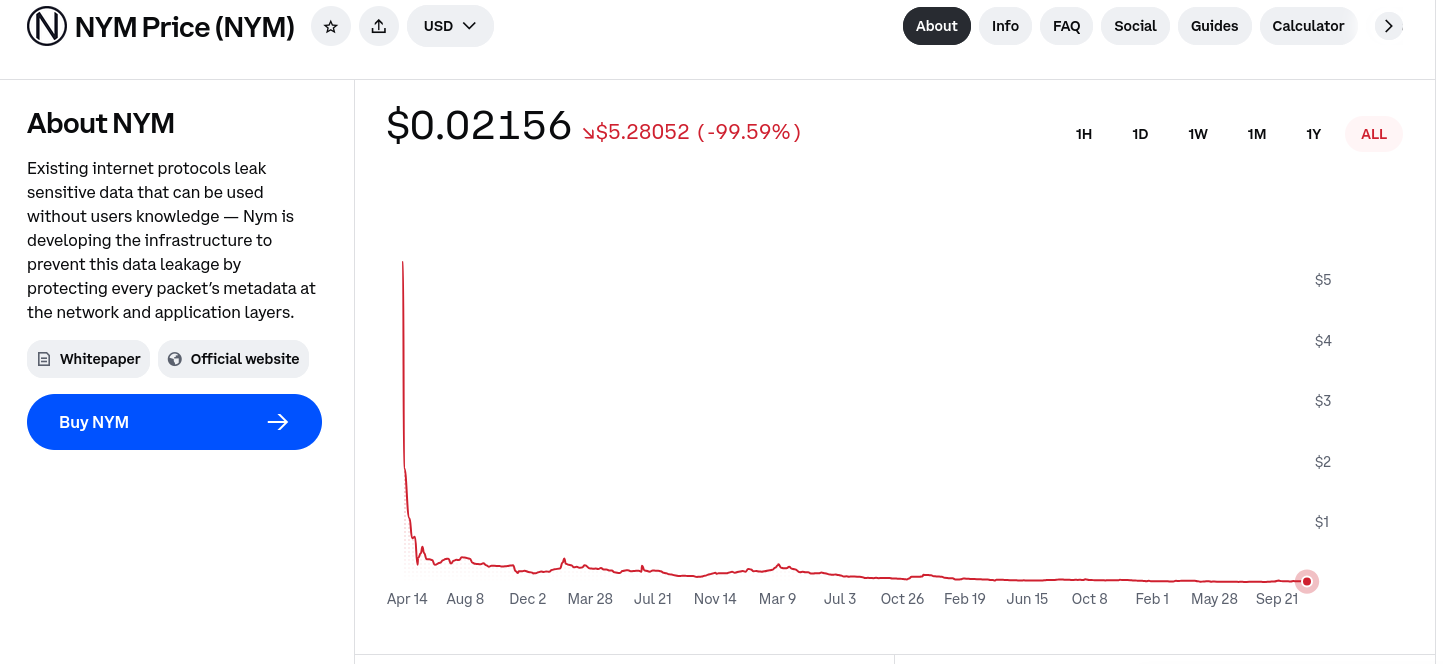
Well, I'd be lying if I said that was encouraging. While it may have been worth something to the company originally, it very much is not anymore. I would hazard that at being 0.41% of its former value, you probably won't be paying in NYM to get that 75% discount.
This whole structure does also rung some alarms for me. Now, I do want to preface this with: NYM is explicitly called a "utility token". Its primary purpose is not economic value supposedly. Now I put my conspiracy hat on and say theorize that one could perhaps build a service, and that service requires a buy in, and the goal of the service is to grow its user base which would mean both a stronger product because it is a participatory network, as well as more people using the crypto which would increase the value. That increased value if things went right would give financial gain to the company because when the cypto can be used to pay for the VPN, that means that the company would have an outsized supply where it is consistently being concentrated through payment to said company. That way if the crypto ever gained a semblance of value, the company would become immediate millionaires or more depending on the market cap. This could hypothetically, allegedly, supposedly, maybe be called a scam or something related. While it does seek to provide some level of legitimate value to people who are in on it, since then their crypto that they earn is worth more and the VPN is cheaper, it doesn't make it not a get rich quick scheme.
Interestingly, for a crypto for a service that claims to keep things as private as possible, if you go to their payment page and look at payment options, NYM is not listed as one of their secure payment options. You'll have to take my word on this part. The website seems to have some funny business making it hard for internet archive to save anything and gets in the way and none of the old saves I clicked on were able to do full saves of the page, missing information at multiple points.
For secure payment, they have Zcash, real paper cash, Taler, and I think they added Monero, but it's not a great logo so its a bit hard to tell. Monero was not there a few months ago, despite being one of the standard privacy-by-default crypto currencies out there. I suppose it is good they changed that, but Monero is "old" and well established, and why isn't NYM private-by-default as well considering the nature of their services?
When learning about this and crypto privacy, I stumbled across quotes of Edward Snowden endorsing Monero as a more privacy focused crypto than big names like bitcoin, or that he used Monero himself. That said, he has since participated in the creation of Zcash as a truly private currency and a better alternative, though there is lots of speculation about if he got paid large sums of money to say so. That said, Zcash is privacy-optional, which doesn't seem like the most privacy-hardened approach, but the Organization behind Zcash themselves recommend a shielded wallet, so there's that. Admittedly, I am not in the space enough to substantiate one way or another, merely following the tail of something odd I noticed about what private payment options there are.
On the topic of Edward Snowden, Nym also featured his image and quote next to their "Tech Advisors," namely Chelsea Manning and Ben Laurie, that one could allegedly, hypothetically consider a misleading move to make it look like Edward Snowden was involved in Nym's Development. This has now been changed as his image has been taken down, and interestingly, they seem to have had to change Ben Laurie's title, suggesting that he may not actually be a Tech Advisor on the project. They also roped in two other unaffiliated professionals who said a couple words about NYM to bolster the section in Snowden's absence. Notably, Chelsea Manning is the only person of the 5 they have displayed that have stayed consistent for as long as they have had the section on their site.
Now we get to go a bit above my pay grade, where I can't judge things one way or another, but I will say, there do seem to be smart and dedicated people working on this. As far as I understand, it probably does work very well, and is under continued development.
My question is: how well does it actually protect your data? Can you still be tracked by ISPs or others?
As far as I can tell, the Mixnet mode is pretty good. While I do have to rely on marketing, the Sphinx encryption makes all packets look the same so they can't pick out one piece of data over another. It is all unreadable, and they use zero-knowledge proofs and quantum-resistant encryption methods (they like to use the words "post-quantum" but that's sniffing their own farts a bit much). There can be multiple layers of encryption making it extremely hard to crack, and mix the data flowing through nodes of different users and adding bits of latency so they can't be tracked sequentially or in any way that expects a simple consistent flow of information. It also goes through 5 hops which is a pretty solid amount. So as far as the Mixnet goes, it is extraordinarily slow, so you might want to only use it for text files and grab a cup of tea, but it seems pretty reliable.
The regular side of the VPN (dVPN) though? Very different story.
They claim that they are working on adding noise to their wireguard implementation, but it isn't there yet, and it lacks much of the protection the Mixnet provides. That said, that is why it is quicker and actually usable for general internet tasks. For now, don't expect much more than your average VPN in this mode. It reroutes and encrypts your traffic so it doesn't come directly from your system, and currently that is more or less it.
Some worry about age verification or identity tracking in payments, but Nym does go out of their way to address this, being actively anti-verification, and when they do absolutely have to use verification, they use systems that operate on credential validity instead of sharing information for payment methods. This allows each account to be verified and access the network without giving access to your name, card number, or other information. What the concern is the Reddit post and that others may share is more likely saying that governments who have a duty to their people should be employing the same technology, if at all, so that data breaches like this stop happening. For example, the age verification roll out on Discord and exposed about 70,000 people's personal information in Australia alone could have prevented that by using the W3C Verifiable Credential system that Nym does. Not to be interpreted as Nym wanting verification.
A couple last notes before we wrap up. I do not particularly trust a company that makes it hard to archive their site with loading a page and then blocking it. I do not like how inconsistent and misleading some of their more marketing-focused sections are. They also talk about introduced noise in their Mixnet, and I thought I read something about using AI for that, but I may be totally mistaken. Maybe it is just additional packets to the sphinx encrypted ones, and thus would be functional and fine, but it is a loose end I couldn't find and perhaps am just mistaken. I would discard the thought if it wasn't for how often the site plays tricks and has little misleading changes on it, but want to point it out as something for people to maybe be aware of if it was real. Apologies for not substantiating this one.
It's important to push through marketing, and helps to pay attention for a while, because as said, it is marketing. It can mislead buyers to get a service that may not work as well as they would like you to think. I want to like this service, but I mostly have reasons to not trust it.
Maybe it is the best VPN, or one of the best. Maybe I will use it one day, but that day is not today. I love the lengths that they are going to protect people's information and that they are open source and audited. I need them to be an organization I can trust though, and right now, I'm just not seeing that from the broader company that Nym is. I hope they can buckle down and change that. Maybe this is the right VPN for you though and you can go in with eyes a little more open. Either way, here's to due diligence and the people trying to make a more private and secure tech space.